Get a Free Trial

How Employee Learning Behaviors Amplify Workplace Potential

The continuous evolution of employee learning behavior is a crucial element that underpins organizational growth and innovation. The ability to create an environment that cultivates effective learning behaviors is paramount in driving workforce agility and adaptability. The strategic advantage of nurturing and understanding employee learning behavior is essential for encouraging a culture of continuous improvement and innovation. In this article, we will learn about the essence of learning behaviors in the workplace and how they can be strategically implemented to boost a team’s potential.

The Essence of Employee Learning Behavior

Employee learning behavior refers to how individuals in an organization seek out, engage with, and assimilate new knowledge and skills. It’s a multifaceted construct that encompasses the desire to learn, the ability to learn from mistakes, and the application of newly acquired skills to solve real-world problems. Why is this important, you ask?

Because in the dynamic theater of modern business, the ability of an organization to innovate and adapt rests on the shoulders of its employees. Their learning behaviors are the engine of workplace innovation, driving everything from process improvements to the creation of revolutionary products and services. In essence, fostering positive employee learning behaviors is akin to laying the foundation for sustained organizational growth.

Strategic Implementation – A Step-by-Step Approach

So, how can organizations strategically nurture these learning behaviors?

First, it begins with leadership’s commitment to learning as a core value. This means creating a safe environment where curiosity is encouraged, and failure is seen as a learning opportunity, not a setback.

Next, organizations need to leverage technology, like AI-powered platforms, to personalize learning experiences. By understanding and accommodating different learning styles, companies can ensure that learning is not only effective but also engaging for everyone involved.

Furthermore, integrating social learning into the workplace, by encouraging collaboration and knowledge sharing, can significantly enhance learning outcomes. When employees learn from each other, it not only boosts their skills but also strengthens team bonds.

Lastly, setting clear goals and providing regular feedback are essential. Employees should know what they’re working towards and how their learning contributes to their personal growth and the organization’s objectives.

Assessing the Impact – Metrics and Tools

Measuring the impact of learning behaviors on organizational performance is critical. It helps in understanding what’s working and what’s not, allowing for timely adjustments. Key metrics include employee engagement scores, the rate of innovation, and overall productivity levels.

Platforms like Courseplay provide invaluable data on learning progress and engagement. Advanced analytics can help pinpoint the learning styles and methods that yield the best outcomes, enabling continuous improvement of learning strategies.

Conclusion

As we move further into the technological world, the evolution of learning behaviors will undoubtedly continue to shape the landscape of workplace innovation. Organizations that recognize and invest in nurturing positive learning behaviors will not only build a more resilient and agile workforce but will also secure a competitive edge in the marketplace.

Encourage your team to embrace learning as a lifelong journey and create an environment that celebrates learning and innovation. By doing so, you will not only elevate your team’s potential but also pave the way for unprecedented organizational growth.

As leaders in L&D, HR, and corporate management, it is essential to implement effective strategies that enrich learning behaviors within your teams. So, what are some effective strategies have you found most effective?
The Importance of Employee Learning Experience and How AI is Enhancing it

In today’s fast-paced and constantly evolving business landscape, employee development is no longer a perk but the success of any organization hinges on the skills, adaptability, and expertise of its workforce. This is where the concept of the Employee Learning Experience (ELX) comes into play. It encompasses the entire journey of an employee’s learning and development within an organization, everything from onboarding to ongoing training, and even the tools and resources available to support learning.

The Significance of an Employee Learning Experience

1. Increased Employee Engagement: Engaged employees are more likely to be motivated, committed, and productive. When employees feel that their organization is invested in their growth, they are more likely to stay with the company and contribute positively to its success.

2. Boost Performance: Continuous learning is directly linked to improved job performance. Employees who have access to learning opportunities and resources are better equipped to handle new challenges and adapt to changes in their roles or within the organization.

3. Enhancing Innovation and Problem-Solving: An environment that promotes learning encourages employees to think creatively and critically. This, in turn, fosters innovation and enables teams to find effective solutions to complex problems.

4. Adaptability to Change: In today’s rapidly changing business landscape, adaptability is a critical skill. Employees who are continuously learning are better positioned to embrace change and navigate through it successfully.

5. Improved Company Culture: A strong learning culture promotes a positive work environment. It conveys the message that the organization values its employees’ growth and development, which, in turn, fosters a sense of loyalty and pride among the workforce.

How AI is Revolutionizing Employee Learning Experience

Artificial Intelligence (AI) is playing a pivotal role in reshaping how organizations approach employee learning and development. Here are some ways in which AI is enhancing the learning experience:

1. Personalized Learning Paths: AI algorithms can analyze an employee’s skills, preferences, and performance to suggest personalized learning paths. This ensures that the training is relevant and tailored to each individual’s needs.

2. Content Curation and Recommendation: AI-powered systems can sift through vast amounts of content to curate relevant resources for specific learning goals. This saves time and ensures that employees have access to the most pertinent information.

3. Real-time Feedback and Assessment: AI can provide instant feedback on assessments and exercises, allowing employees to gauge their progress and make adjustments as needed. This dynamic feedback loop accelerates the learning process.

4. Chatbots for On-Demand Support: AI-driven chatbots can offer immediate assistance to employees seeking information or guidance on various topics. This ensures that employees have access to support when they need it, without delays.

5. Predictive Analytics for Skill Gaps: AI can analyze performance data to identify skill gaps within the organization. This information allows HR and training departments to tailor learning programs to address specific areas of need.

6. Augmented Reality (AR) and Virtual Reality (VR) Training: AI, when combined with AR and VR technologies, can create immersive learning experiences. This is especially valuable for training in complex or high-risk environments.

7. Automated Learning Administration: AI-driven systems can handle administrative tasks related to learning, such as scheduling, tracking progress, and generating reports. This frees up time for HR and training teams to focus on more strategic initiatives.

In conclusion, the Employee Learning Experience is a critical factor in organizational success. By leveraging the power of AI, organizations can not only enhance the learning experience for employees but also drive productivity, innovation, and adaptability. The synergy between human potential and artificial intelligence is reshaping the future of workplace learning and development. Embracing this technological advancement is not just an option, but a strategic imperative for businesses looking to thrive in the 21st century.

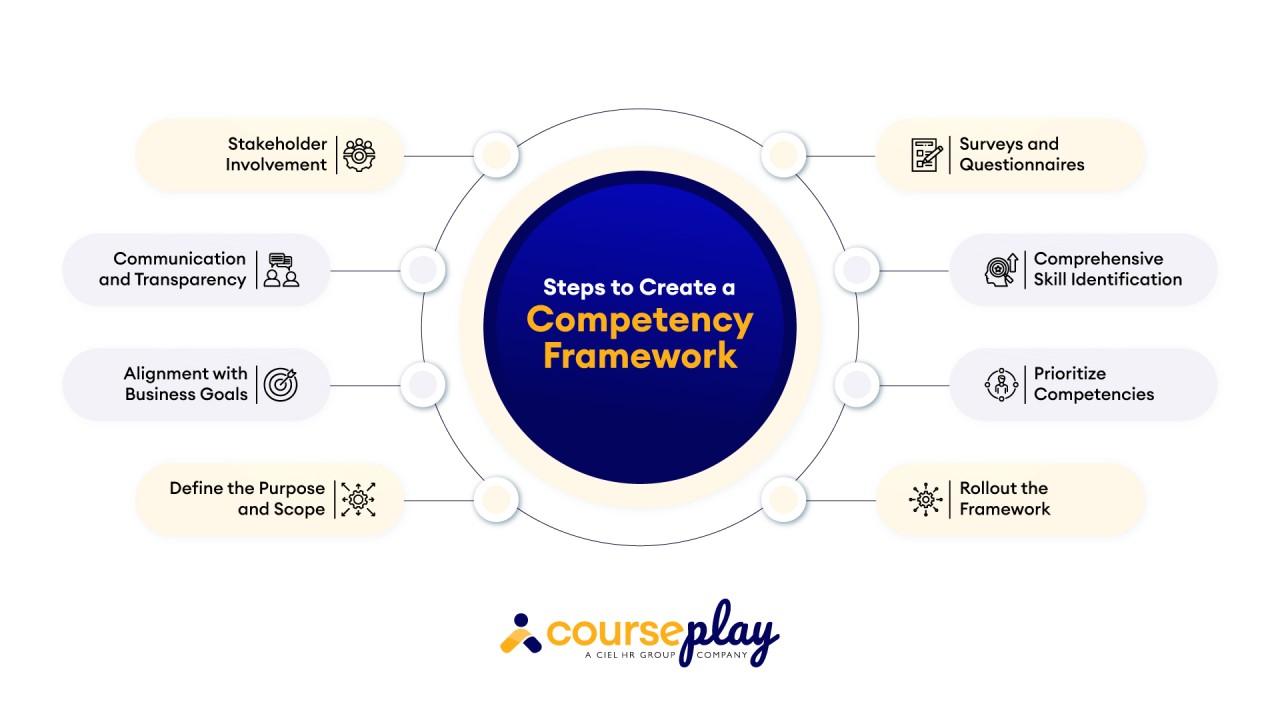
Steps to Create a Competency Framework

A competency framework is a comprehensive strategy that outlines the critical knowledge, skills, abilities, and behaviors required for employees to excel in their roles. It serves as a blueprint for recruitment, performance evaluation, and career development, providing a clear roadmap of expectations to help individuals and teams align their efforts with organizational goals.

The current professional landscape demands a well-defined competency framework for identifying, nurturing, and leveraging the skills and abilities of the workforce. There are many options to help you create the right competency framework. You can use a pre-set list of common competencies. Then, customize it to the specific roles in your organization. You can also outsource consultants to develop the framework for you.

Ensure that the framework is used as needed, and make it relevant to the people who will be using it. This will result in them taking ownership of their roles. In this article, we’ll explore the fundamental principles and steps to create a competency framework that is essential to organizational success.

Prepare

  1. Define the purpose and scope: Clearly articulate the reason for creating a competency framework. Determine whether it’s for a specific role, a department, or the entire organization. Based on the principles, define your clear agenda and prepare a competency framework that will ensure that everyone is aligned to achieve a common goal.
  2. Alignment with Business Goals: A competency framework should be closely tied to the organization’s strategic objectives. Identify and define the specific skills, knowledge, and behaviors that are critical for success within each role and across various levels to achieve the goals. This will ensure that every competency is articulated and understood by the employees.
  3. Communication and Transparency: Clearly communicate the competency framework to all employees, emphasizing its importance in career development, performance evaluation, and overall organizational success. Transparency promotes trust and encourages employees to take ownership of their development.

Collect Information

  1. Stakeholder Involvement: Engage key stakeholders, including employees, managers, and subject matter experts, in the process of developing and validating the framework. In doing so, you will receive a mixture of inputs and diverse perspectives that will help you understand better and ensure buy-in across the organization.
  2. Surveys and Questionnaires: This is an efficient way to gather relevant data and valuable insights into what’s needed for each role to succeed. Making sure to ask the right questions will help you perform a thorough job analysis and help you develop a framework that will help others.

Build Framework

  1. Comprehensive Skill Identification: Identify and define the specific skills, knowledge, and behaviors that are critical for success within each role and across various levels of the organization. This comprehensive approach ensures that every competency is clearly articulated and understood.
  2. Linking to Performance Management and Development: Integrate the competency framework into performance evaluations and development plans. This not only provides a structured basis for assessments but also guides employees in setting meaningful growth goals.
  3. Prioritize Competencies: Prioritize the competencies based on their importance and relevance to the job roles and group them into clusters. You can also split your competencies into hard skills or soft skills to help you focus on development efforts in the most critical areas.

Implement the Framework

  1. Rollout the Framework: Circulate the competency framework with the key stakeholders and make sure that it is properly reviewed. Ensure that the competencies are aligned with the organizational goals and expectations of employees. Once done reviewing, document the finalized competency framework in a clear and accessible format and integrate it with your Learning or HR platform.
  2. Continuous Monitoring and Evaluation: Regularly review and update the competency framework to reflect changes in job roles, industry standards, and organizational goals. Monitoring its effectiveness ensures that it continues to meet the needs of the organization.

Conclusion

Developing a competency framework is an iterative process and a well-crafted framework serves as a roadmap for aligning talent with organizational objectives. It is important to be open to feedback and willing to make adjustments as needed to ensure its continued relevance and effectiveness. By adhering to these steps, you can create a dynamic framework that empowers employees, fosters professional growth, and ultimately drives the success of your organization in today’s competitive landscape. A robust competency framework isn’t just a document – it’s a strategic tool that empowers your workforce to reach new heights.

How to Harness an Employee’s Skills to Get the Job Done

As organizations strive to remain competitive, one of the key factors that can set them apart is the effective utilization of their employees’ skills. Each individual brings a unique set of talents and capabilities to the table, and harnessing these skills efficiently can lead to increased productivity, job satisfaction, and ultimately, success for the organization. However, identifying the attitudes, practices, and states of mind that employees need to do their jobs effectively and measuring their competence can be challenging for employers.

In this post, we will delve into strategies that organizations can use to identify, nurture, and leverage the skills of their employees to ensure that they are not just completing tasks, but excelling beyond expectations. By prioritizing the effective utilization of employee skills and investing in their development, organizations can create a culture of excellence that attracts top talent, fosters innovation, and drives success.

  1. Know Your Team: Begin by understanding the unique skills and strengths each individual brings to the table. Take the time to have open and honest conversations with each individual about their experiences, interests, and passions. By doing this, you can identify their areas of expertise and the tasks they’re most comfortable with. This knowledge serves as the foundation for building a well-rounded team that complements each other’s abilities and fills in any skill gaps. The more you know about your team members, the better equipped you’ll be to create a collaborative and productive work environment.
  2. Provide the Right Tools and Resources: To ensure employees can perform their tasks effectively, it’s important to provide them with the necessary tools and resources. This may include access to various software applications that streamline processes and improve productivity. Additionally, offering training materials that cover specific skill sets or industry best practices can help employees develop their abilities and stay up-to-date with the latest trends. Taking the initiative to provide access to external courses can also be beneficial for employees who want to take their skills to the next level.
  3. Create a Skills-Driven Culture: As an organization, it is essential to promote a culture that values and prioritizes skills. One way to achieve this is by making skill development a part of the organizational ethos. Companies can accomplish this by providing mentorship programs to employees, offering workshops, and incorporating skill-building goals into performance evaluations. This approach not only helps employees improve their skills but also enhances their job satisfaction and motivates them to achieve their full potential. By emphasizing skill development, organizations can create a more competent and engaged workforce, leading to greater success and growth.
  4. Review Performance Effectively: Employee performance reviews are not just a yearly ritual; they are a crucial aspect of talent management and organizational growth. When conducted effectively, performance reviews provide a platform for constructive feedback, goal alignment, and professional development. By facilitating open and honest communication between managers and employees, performance reviews allow for the cultivation of a positive and productive work environment, which is essential for the overall success of any organization.
  5. Provide Tailored Training: Customizing training programs to address specific needs and goals is an effective approach for organizations to enhance the skills and knowledge of their workforce. This approach involves a strategic and individualized method of identifying the unique needs of each employee and tailoring training programs to address those needs. This not only enhances the overall proficiency of employees but also helps them develop a deeper understanding of their roles and responsibilities, leading to higher job satisfaction, lower turnover rates, and increased productivity.

Conclusion: Harnessing an employee’s skills goes beyond simply completing tasks; it’s about unlocking the full potential of individuals to drive organizational success. It encompasses a deep appreciation of each individual’s unique strengths and capabilities, promoting a culture of open communication and providing the necessary resources and support to enable them to thrive. By actively encouraging the application of their multifaceted skills, companies can create an environment that fosters innovation, creativity, and productivity, surpassing their goals and achieving long-term success. Remember, it’s not just about getting the job done; it’s about empowering your team to excel in every task they undertake.

Ways to Build 360-degree Employee Growth

A 360-degree approach to employee development encompasses more than just skill-building. It considers the complete spectrum focusing on enhancing skills, improving performance, and nurturing comprehensive development. Here are ten ways to stimulate 360-degree employee growth within your organization:

Formal Learning

  1. Off-the-shelf Content Libraries: Offering your employees a large library of content is a great way to help them develop their skills through online learning in a low-cost and scalable way. There are many options to quickly plug and play off-the-shelf content in your organization to suit different needs and budgets.
  2. Rewards and Recognitions: These are the key components of employee engagement, motivation, and retention. Setting up gamification features to incentivize learners to complete courses and pull people into learning is a great way to build adoption for your courses.

Social Learning

  1. Development Plans: A personalized framework serves as a roadmap for the individual’s professional development and helps them to ensure that their growth aligns with organizational objectives.
  2. Peer Learning: It emphasizes learning through interactions with peers who work together to achieve common learning goals. It creates a supportive community where individuals can share their thoughts which will help them develop their interpersonal skills and contribute to the collective learning experience.
  3. Feedback and Reinforcement: It involves a mechanism where an individual receives feedback from their peers, manager, and others regarding their strengths and areas of improvement. It helps individuals align themselves toward specific goals or objectives. Effective feedback provides guidance and information, while reinforcement provides incentives for desired behavior, ultimately contributing to the improvement of performance.
  4. Collaboration and Interactions: Create a culture of knowledge sharing of do’s from the top performers down, and don’ts from the bottom performers up. It encourages and enables individuals to leverage the collective intelligence and capabilities of a team.

On-the-Job Learning

  1. Learning by Doing: It is a dynamic and effective approach to developing skills as it actively engages learners in the learning process, leading to deeper understanding and more effective learning outcomes.
  2. Skill Development: Individuals can acquire and refine skills and competencies that are relevant to a particular job. It is not only limited to professional or technical skills but it also encompasses personal or soft skills to adapt in a rapidly changing environment.
  3. Continuous Improvement: Encourage a culture of continuous improvement where employees can constantly seek ways to enhance their performance, find more efficient methods, and achieve organizational goals. It drives a culture of innovation, adaptability, and excellence, driving sustainable success in today’s changing business environment.
  4. Learning Ownership: This is a proactive and self-driven approach to learning and development which involves taking responsibility and accountability for learning, skills, and competencies. They honestly engage in practices to evaluate their progress and identify areas for further development.

Conclusion: Adopting a 360-degree approach to employee growth is not just a good practice; it’s a competitive advantage. Engaged, skilled, and motivated employees contribute significantly to achieving organizational goals. By providing opportunities for continuous learning, constructive feedback, and holistic development, you’re investing in the future, creating a win-win situation for both employees and the organization.

The path to employee growth is unique for each individual and platforms like Courseplay focus on providing formal, social, and on-the-learning which will help individuals to meet the specific organizational goals. Build a workforce that’s not only highly capable but also deeply committed to the success of your organization.

Blended Learning and Our 6 Key Training Principles

At Courseplay, we have used principles taken from cutting-edge research to make sure that courses taken on our platform deliver long-term and measurable results. We follow the Blended Learning approach to make sure that knowledge is retained as quickly and efficiently as possible. Our training principles are woven into the Courseplay application. Here are our 6 key principles:

  1. Courses must make a personal connection with the learner
  2. Learning content must be easy to digest, but not boring
  3. Courses must cater to learners with different learning styles
  4. Courses must be interactive as interactivity between learners reinforces lessons
  5. When learning online, consistency is key
  6. Learners must have control over time, place, path, or pace

Blended learning with Courseplay is not the same as “technology-rich instruction”. It goes beyond one-to-one computers and high-tech gadgets. We leverage the Internet to afford each learner a more personalized experience, meaning increased learner control over the time, place, path, and/or pace of how they learn, which results in better retention and better results.

The Value of an Online Course

Being a cloud-based platform for training, many clients, especially those who are training their people for the first time, often ask us how valuable online courses can be. At Courseplay, we have prepared a little note to understand the value of an online course. Understanding the value comes down to two main factors: the course and the learner.

The Course

The first factor is whether the course brings together an adequate amount of information and goes deep enough into the subject matter. It’s easy to make a cluttered course with tons of unnecessary information without a logical structure. The real challenge comes in creating a course that is well structured and only contains the required content. There is also the risk of going too far on the other end of the spectrum making the course too vague and not going deep enough into the subject.

An additional point about course creation worth noting is that factors like information accessibility, choice of words, methods of evaluation, and media types go a long way in improving the value of a course and have a tremendous impact on how information is retained.

The Learner

This is something that many may find counter-intuitive, but the learner plays a big role in creating value for a particular course. If there is a mismatch between the course and the learner, it is an exercise in futility.

The learner’s attitudes, preferred methods of learning, and willingness to learn come into play here. If they are being forced to take the course, are not being engaged by the content, and would rather be taught in a classroom, there is no value in the course for them. Learners must understand how they learn most effectively and leverage that to maximize the value of a particular course.

Just as important is the learner’s ability and willingness to set aside time, log in to the program, and FOCUS.

The Big Question

At the end of the day, administrators, authors, and learners have only one question to ask to understand the value of an online course: How did this course help the learner gain new skills and apply them in a real-life situation for their benefit?

To get the answer to this question, it is important to track the skill level of a learner before taking the course and then record the skill level after the course has been completed. This is the best way to measure tangible outcomes from any learning program.

Additional points to consider:

  • Is the course material relevant to the skill that the learner is looking to obtain?
  • How will the course benefit the learner?
  • Does the learner have a choice in taking the course?
  • Is the course worth the time and effort for the creator and the learner?

With Courseplay, course authors can create surveys and quizzes that can gauge the skills of a learner before and after a course and use that data to measure the value and impact of a course. To learn more about how you can use Courseplay at your organization, contact us.

Three Steps to Corporate Training with Courseplay

The problem with any good enterprise software these days is the over complicated interface. There are so many settings to choose from that it overwhelms the technophobes and slows down the technophiles. At Courseplay, we are constantly trying to simplify the interface but at the same time offer the more advanced features some clients require. For all those wishing to quickly roll out courses, follow these three steps.

Step 1: Add Users

This is a one-time investment as once your users are added, you probably won’t need to add them again. Simply click on the Users section, and you can either add users individually or bulk import them using our template.

Step 2: Add Courses

This is slightly more time-consuming but it certainly helps to plan your courses out beforehand to quickly upload all the modules. Courseplay allows users to add videos, PDFs, and even SCORM content!

Step 3: Assign Users to Courses

Once the course is finalized and published, instructors can click on the Goals tab to assign users to the course. Only those users for whom this course has been assigned as a goal are permitted to enroll and begin the course. Others may add the course to their wish list so that they may be assigned this course as a goal in the future.

Using our simple three-step process, any organization can quickly and easily implement any training program with Courseplay!

The Real Cost of Training

Inc Magazine author Robert Hoffman wrote an article many years ago about the cost of training the workforce in a company or an organization. While many companies have switched to an online system to lower training costs since then, many still train their people the traditional way.

In addition, training is seen as a cost center in companies, with a last-in-first-out approach. As soon as a company sees signs of tough times coming up, the training program is cut. This creates a vicious circle in the company because untrained employees are less effective and thus less likely to turn the company around. If companies use the right tools, an online training solution can be just as effective as any other kind of training, and lower costs at the same time. Companies will also get the added benefit of useful data that helps them understand their employees more thoroughly.

We will use Robert Hoffman’s article to explore the cost of training once again but modernize it with the latest solutions available today. This article is for those companies, schools, and organizations that are looking for an online or even a hybrid solution but need more information about the training costs that will be incurred or the savings they will make.

  1. Facilities: Where will the training be conducted? Are hotel rooms or a meeting space required? If the training is Web or computer-based, are specific resources dedicated to the equipment, utilities, software, and hardware maintenance? Are participants reimbursed for lodging when they attend overnight training? — These are some of the biggest expenses with training and grow exponentially as the organization gets bigger. But there is hope. Courseplay is a web-based solution, where we take care of the server, equipment, utilities, software, and hardware maintenance. Clients only need an internet connection and a device (any device) to access the training program. They can access the program from anywhere. We charge on a pay-per-use basis and clients can upload their programs for free or we can help them. Isn’t that convenient?
  2. Instructors: Are facilitators paid a salary, per diem, or billed by an outside firm? Are trainer expenses considered? Does the company have to pay to certify the instructors or pay any license fees to use the materials? — Booking instructors to train employees every time can get expensive. What if you just booked your instructors to record the training content once, and let the content do all the work? We can complement your in-house or outsourced training team to create tailor-made online training content for your organization based on our tried and tested ‘Learning Principles’. If you don’t have a training team, we can connect you with our team to get the job done!
  3. Participants: What are the combined salaries and benefits costs that will be dedicated to the time spent on training? What is the price for the time spent out of the office, at seminars, traveling, or preparing for training while still at work? — Many times the training costs aren’t justified because of the loss in productivity the participants face to get trained. On average, companies spend 2% of the employee’s total cost-to-company on training. If the training costs are greater than that, it isn’t worth it to train the employee. Plus, if the employee leaves soon after being trained, not only is the expense wasted, but the entire benefit goes to your competitor. With Courseplay, the cost of training comes down, way down, so that the benefits of training far outweigh the costs.
  4. Material format: What type of materials will be used? Is the media, books, tapes, CD-ROM, Web-based, or video? How will the material be obtained? Any shipping, packaging, or transmission costs? If the material is developed in-house is the talent available or must the company recruit the technical expertise? Will the materials still be timely and technologically relevant when the training is delivered? If not, what are the redesign costs? — Yet another expensive proposition. At Courseplay, we give clients the option of uploading their content, licensing from our Marketplace, or using the services of our team to create bespoke courses just for them. Content can be updated as and when needed—no shipping costs. No hassles.
  5. Communication and marketing: Will materials be produced to generate interest in the training? Brochures, pamphlets, direct mail, postage, and Web sites all have development costs in addition to material costs. Will time be spent by senior managers selling the training internally? Will employees be actively solicited through kick-off and information meetings? How much time will be spent learning about the training? Courseplay is a digital training tool which means that while communication and marketing costs are minimal, the features are baked into the application. Senior managers can assign courses to their teams as goals and track their progress on our dashboard. Administrators and instructors can post category-specific announcements to provide important updates on courses. Development costs are zero as the system comes ready-made for our clients. In addition, our platform is designed to be engaging so that learners are not bored and they keep coming back. Just plug and play!
  6. Tuition reimbursement: What is the cost of the actual benefit as described in the company policy? What is the level of utilization by the employee population? What are the costs of communicating the program and processing the benefit? Does the company policy exclude reimbursement for unsuccessful completion of course requirements? — These are very important issues that factor in to the training costs indirectly. Fortunately, Courseplay allows clients to manage and measure the utilization as well as the benefit of the training program. Our reporting dashboard allows clients to easily see the progress each participant has made in each course. We also conduct delayed impact analyses to measure the benefit of our training programs in the workforce.
  7. The learning curve: How long does it take for the employee to get “up to speed?” What are the adaptation costs, the costs of potential mistakes while in the learning process? If the employee is in a production type situation, what is the cost of lost production on an incremental basis, if the employee had been fully trained from the start? Courseplay allows course creators to create pre-course surveys before a course starts to gauge the pre-requisite knowledge that a participant may or may not have to continue with the course. Speaking of learning curves, our platform is designed using interface elements from websites that our users are already familiar with. We don’t need to train you on how to use Courseplay because you already know how to use the platform!
  8. Productivity inhibited: What would the employee be doing if they were not taking time from their regular tasks to be trained? Would more income be generated for the company? How would that time be used more profitably or effectively? Could the time have resulted in the development of new accounts or products, faster production, or greater organizational efficiency? Courseplay has long wondered the same thing. With Courseplay, your learners can access course materials from anywhere. They can train while on their daily commute, during free time at home, or during down time at the office. Courseplay works responsively on all devices. We offer tailor-made applications that can complement your training platform to measure additional metrics that would otherwise be hard to capture.
  9. Company culture and expectation: Some organizations have massive expectations from the image and culture they communicate through their training experience. Training may dominate company culture and be a catalyst for many associated programs that are developed to enhance the training experience. Promotion and reward systems may be geared towards the training effort. Incentives may be given when training is completed or goals that training addresses are attained. All of these expectations result in higher per-capita costs — per employee. Additionally, the per-capita cost may be far greater because training-intensive companies tend to use the most sophisticated methods and expensive materials. This is a non-issue for Courseplay. Courseplay can be used in any organization in any way they like. Our job is to simply reduce training costs and increase the benefits companies get by using a simple yet powerful training platform.

Click here to start a free trial of Courseplay today!

Implementing your Learning Management Solution

There are three key C’s in implementing your Learning Management System in your organization. They are Configuration, Communication, and Content.

Configuration

Some LMS solutions will require a significant amount of effort from the organization’s side to install and configure the LMS as per the organization’s needs. FYI, with Courseplay, this is 0. Courseplay comes pre-configured and ready to use from the word GO. Others however would need a small team. Beyond installation, certain settings will vary from organization to organization that has to be set up.

Communication

The key to implementing any new system in an organization is communication. With a LMS there are two main levels of communication.

  1. The first is the organization’s policy. Who is in charge? Will online training be mandatory? Who will be trained? How often? Why? All this and more must be communicated to the organization.
  2. The second level of communication has to do with the LMS features. Many service providers give you a lot of documentation and training so that the implementation process is as seamless and hassle-free as possible. Beyond that, working with the people at the organization to iron out any questions, comments, or concerns they may have will also help.

Content

In the long run, after the LMS has been configured and everyone knows what to do with it, someone needs to manage the content. Which courses should be purchased or created? Who will upload and manage the courses? Which employees should take these courses? Who will oversee the employees?

Other considerations: Beyond this, it’s important to keep the timeline, budgeted costs, expectations, and goals of the endeavor in mind.

At Courseplay, we do all this and more. We take care of the entire implementation process for our clients. Contact us if you have any questions, comments, or concerns. We are happy to help.

Thanks — your message has been sent! Our team will get back to you shortly.
Something went wrong sending your message. Please check the form and try again.
Please use your business email address to submit a partnership enquiry.

Talk to Sales

Tell us a bit about your organization and we’ll set up a personalized demo.

We typically respond within 1 business day.