Author: Courseplay

Transforming Aviation Training Management_ Building a Centralized, Compliant and Scalable Learning Platform

From Training Calendar to Capability Engine: What FMCG’s Workforce Shift Actually Requires
The training calendar was built to run programs. The capability engine is built to close gaps. FMCG organizations that treat them as interchangeable are losing ground to competitors who don’t.
Every industry eventually hits a point where the old operating model stops matching the problem it’s solving. Retail hit it when e-commerce overtook foot traffic. Supply chain hit it when “get the product to the shelf” became “get the right product to the right shelf, predictively.” FMCG workforce development is at exactly that moment right now.
For three decades, L&D in FMCG has run on one assumption: publish a training calendar, run the sessions, track completions, check the compliance box. It worked when the job was stable. That job doesn’t exist anymore; the workforce is asked to run AI-enabled dashboards, operate smart supply chains, and sell across omnichannel platforms faster than any calendar was designed to support.
The problem is no longer “how do we deliver training to a large, distributed workforce?” It’s “how do we close a specific capability gap, in a specific role, before it costs us a customer, a shipment, or an employee?” That’s a capability-building challenge, not a scheduling one, and it requires L&D to evolve into systems that see where the gap is, close it in the flow of work, and prove it moved the numbers leadership cares about.

What a Capability Engine actually does differently
The frontline reality in FMCG makes this distinction concrete. A warehouse crew on rotating shifts, a merchandiser in a different city every week, a sales rep who needs one dashboard skill, not a curriculum — all break a training-calendar model in a way that quietly costs the business. Frontline hiring and retention alone account for roughly a third of all hiring pressure across FMCG, and every day a capability gap sits open on the floor, that pressure compounds.
A Capability Engine assumes that learning should respond to a real gap, not a fixed schedule. In practice, that means three shifts in how the system works:
Fixed calendar → Continuous, role-based delivery
Instead of pushing the same module to every merchandiser regardless of need, a capability engine delivers precisely the skill a role requires, when the gap shows up, not when the calendar says it’s time.
Generic content → Targeted, mobile-first intervention
A warehouse supervisor and a category manager don’t need the same course. Digital, AI, and data skills are now the single largest capability gap across FMCG; ahead of supply chain, commercial, and leadership skills combined.
Completion tracking → Business-outcome tracking
Completion rates tell you what was consumed. Capability engines track the gap between where an employee started and where they are now, and connect that movement to productivity, retention, and operational efficiency; the numbers reported to leadership.
What this means for how FMCG buys L&D technology
Content management and compliance tracking remain necessary, but they’re no longer sufficient. Organizations are increasingly evaluating platforms on whether they close capability gaps tied to productivity, supply chain efficiency, and frontline retention, not just whether they can schedule and deliver a course. The right questions to ask a learning platform in 2026 aren’t about content libraries. They’re about whether the system can reach a distributed frontline workforce and prove the gap actually closed.

What this means for how FMCG builds its L&D strategy
In a training-calendar world, L&D’s primary job is running programs: building courses, scheduling sessions, managing enrollments, reporting attendance. Valuable work, but increasingly disconnected from the outcomes leadership is accountable for; frontline retention, digital skill readiness, operational agility.
In a capability-engine world, L&D’s job becomes defining which capability gaps matter most to the business, setting the conditions for continuous, role-based development, and interpreting the signals the system surfaces, rather than running the coordination manually.
The L&D teams that matter most over the next five years in FMCG won’t be the ones that ran the most training sessions. They’ll be the ones who closed the most capability gaps before those gaps became attrition, errors, or lost revenue.
Why this matters now, not eventually
FMCG isn’t a slow-moving category anymore. Corporate learning investment tied to the sector is already growing faster than the industry itself — evidence that leaders already sense the old model isn’t holding. The organizations moving first aren’t waiting for a perfect moment: they’re starting by connecting learning to the roles and regions where attrition and skill gaps are sharpest, then expanding from there.
The starting point matters less than the direction. The question isn’t whether FMCG workforce development eventually runs on a capability engine instead of a training calendar. It’s whether your organization builds that infrastructure now, while it’s still a competitive advantage, or later, once it’s table stakes and your competitors already have the head start.
Courseplay is built for exactly this shift; role-based, AI-enabled capability development that reaches frontline and distributed FMCG workforces where they actually work, not just where a training calendar says they should be. That means closing the specific gap in the specific role, proving the capability change, and giving L&D leaders the evidence they need to defend the investment to the business.
If you’re evaluating learning infrastructure for your frontline and distributed workforce, the conversation should start with reach and proof, not just content.
Follow Courseplay and subscribe to The Learning Loop Newsletter for more on workforce transformation and L&D strategy.
The Future of Learning: Are We Really Ready for Personalization?
Learning is personal. We’ve all heard that before. Yet, how often do we see companies truly embracing this idea? The reality is, many organizations are still relying on traditional, one-size-fits-all training models, waiting for the inevitable shift before they invest in something better.
The workplace today demands agility; skills become obsolete faster than ever, and employees expect learning experiences that align with their unique needs. But despite advancements in technology and a growing emphasis on employee development, personalized learning remains more of an aspiration than a reality in many companies.
So, what’s holding organizations back?
- Fear of Complexity: Customization sounds complicated. Creating tailored learning paths, adapting content, and tracking the progress of each employee can seem overwhelming, especially for companies with large workforces.
- Resource Constraints: Many L&D teams operate with limited budgets and manpower, making it difficult to move beyond standardized training programs.
- Mindset Shift: The biggest challenge isn’t technology or resources, it’s the mindset. Learning isn’t just about ticking boxes; it’s about building a culture where employees take ownership of their development.
Are We Moving Beyond ‘Training’ to ‘Learning’?
Forward-thinking organizations are already challenging the status quo. Instead of pushing pre-defined training modules, they are integrating learning into everyday workflows, making it more organic and relevant. The focus is shifting from structured courses to continuous, real-time skill-building. Some of the most impactful changes we’re seeing include:
- Adaptive learning paths that evolve based on an employee’s role, goals, and performance.
- AI-driven insights that recommend learning content tailored to an individual’s career aspirations.
- Embedded learning experiences that fit seamlessly into daily work rather than existing as separate, scheduled events.
The question is – are organizations ready to move beyond the conventional and truly empower employees with learning that matters? Or will they wait until they are forced to change?
Follow Courseplay LXP | LMS | PMS and subscribe to The Learning Loop Newsletter for more on workforce transformation and L&D strategy.
The Frontline Cliff: Why FMCG’s Biggest Growth Story Has a Talent Problem Hiding Inside It
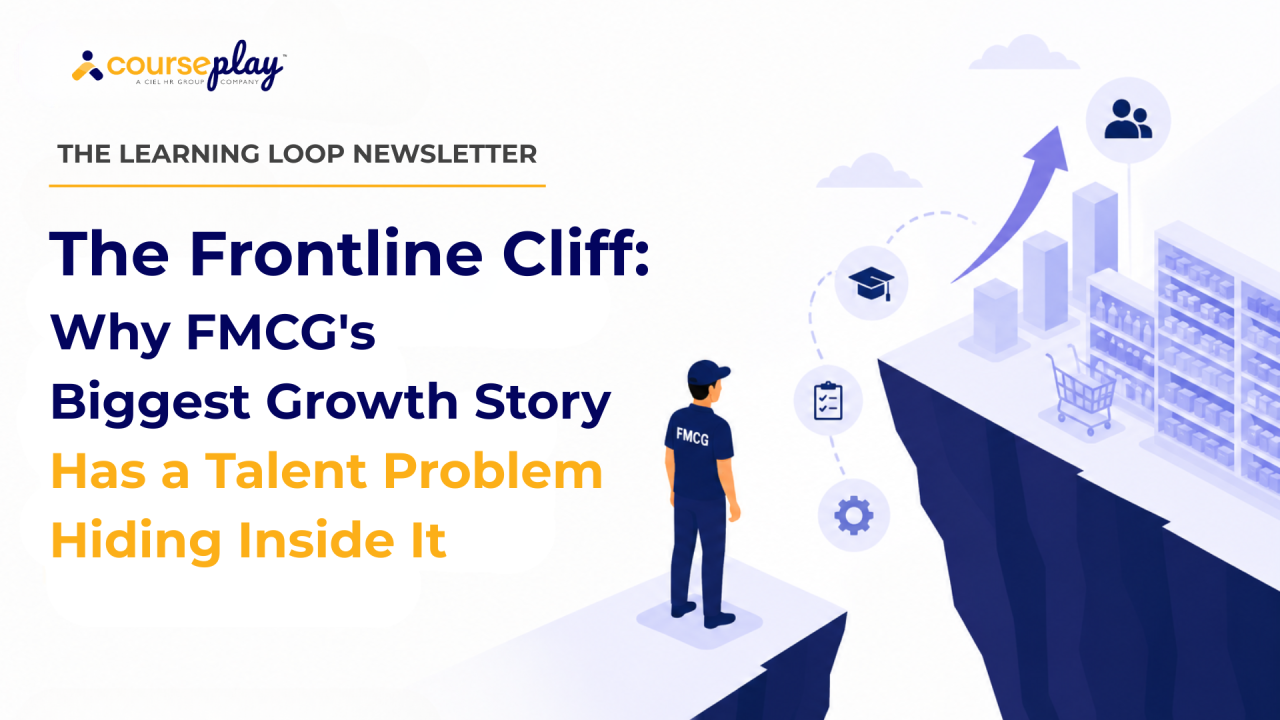
The global FMCG industry is on a straight line up. USD 13.6 trillion in 2025. USD 19.9 trillion by 2032. A steady 5.6% CAGR, carried by digital commerce, urbanization, and a growing middle class that wants more, faster.
Look one layer beneath that curve and the story gets more interesting. Corporate L&D spend tied to Retail & FMCG isn’t growing at 5.6%. It’s growing at 9.7% – the fastest of any industry vertical tracked, outpacing IT & Telecom, BFSI, and Healthcare. From USD 69 billion in 2025 to USD 131 billion by 2032.
That gap between “the business is growing steadily” and “the investment in people is growing almost twice as fast” is not a coincidence. It’s a warning sign. FMCG leaders are quietly admitting that the workforce underneath the growth curve isn’t ready for it.
The Real Bottleneck Isn’t Demand. It’s People.
Ask FMCG leaders what keeps growth from translating into results, and the answer isn’t market size or supply. It’s the workforce itself. Frontline hiring and retention alone account for 34% of all hiring pressure across the sector – more than skills gaps, more than supply chain shortages, more than leadership gaps combined with anything else on the list.
Scale, distribution reach and brand strength used to be the whole game in FMCG. They still matter – but workforce agility and capability have become just as critical to winning.
Sales teams, warehouse crews, merchandisers, and retail execution staff are the largest, most visible, and most under-invested population in the industry. They’re also the population closest to the customer, the shelf, and the truck. When that layer is stretched thin, every efficiency gain the business makes upstream gets absorbed downstream by attrition, retraining, and inconsistent execution.
Three Forces Are Colliding at Once
AI, advanced analytics and cloud are the single largest driver of workforce transformation in FMCG right now – accounting for 32% of the technology shift reshaping the sector, ahead of IoT and smart supply chain (22%), digital commerce and CX tech (18%), and automation and robotics (16%).
That technology wave is landing on a workforce that is simultaneously:
- Large and distributed – frontline populations spread across plants, warehouses, and retail floors, far from a classroom or a corporate campus
- Digitally under-skilled – asked to run analytics dashboards and omnichannel tools they were never trained on
- Structurally hard to retain – high attrition roles where every departure resets the learning curve to zero
Upskilling priorities across the sector reflect exactly this pressure: digital, AI and data skills now account for 32% of upskilling focus – more than supply chain and operations (24%), commercial and digital commerce skills (18%), automation and engineering (14%), and leadership and cross-functional skills (12%) combined don’t outweigh it.
Why the Old L&D Model Can’t Keep Up
Most FMCG L&D functions were built for a different job: run the induction week, deliver the compliance module, tick the box. That model assumes a workforce that sits still long enough to be trained once and stays put long enough for it to matter.
Frontline FMCG teams do neither. They’re mobile, shift-based, multilingual, and constantly turning over. A six-hour classroom module doesn’t reach a warehouse worker on a rotating shift. A generic digital-skills course doesn’t help a merchandiser who needs one specific capability – reading a retail analytics dashboard – not an entire curriculum.
That’s why the shift underway is one from periodic, compliance-centric, generic training toward continuous, role-based, AI-enabled capability development – learning that lives inside the flow of work rather than pulling people out of it.
What Leading FMCG Organizations Are Doing Differently
The pattern across the fastest-growing L&D investment isn’t “more training.” It’s more targeted infrastructure:
- Solutions over services. The Solutions component of corporate L&D – platforms like LMS and LXP – is growing at 14.7% CAGR, more than double the growth rate of traditional training services. Enterprises are buying infrastructure, not just content.
- Personalization over generic content. Role-based learning paths replace one-size-fits-all modules, so a warehouse supervisor and a category manager aren’t sitting through the same course.
- Business KPIs over completion rates. Capability development gets tied to productivity, supply chain efficiency, and retention – the metrics FMCG leadership actually reports on.
The Question Worth Taking Into Your Next Leadership Meeting
If frontline hiring and retention already account for a third of your hiring pressure, and digital, AI and data skills are your single largest capability gap – what happens to both numbers if your training infrastructure hasn’t changed in five years?
FMCG’s growth story is real. Whether individual organizations capture their share of it will come down to whether workforce capability keeps pace with the technology curve, or falls further behind it every quarter.
At Courseplay, we build the learning infrastructure for exactly this problem – role-based, AI-enabled capability development that reaches frontline and distributed workforces where they actually work, not just where a classroom happens to be.
Follow Courseplay LXP | LMS | PMS and subscribe to The Learning Loop Newsletter for more on workforce transformation and L&D strategy.
How to Create a Continuous Learning Loop Inside Your Organization
Organizations talk about building a “learning culture” all the time. But when you look closer, learning is still treated as a one-time event. A big onboarding session. A compliance module. A quarterly leadership workshop.
The problem? Once the event ends, so does the learning. Employees return to their day-to-day work and most of what they just learned is forgotten in a matter of weeks. This is why L&D often gets labeled as a cost centre where time and money go in, but the long-term impact feels invisible.
The truth is: in today’s environment, this approach simply will not work. Roles are evolving faster than job descriptions, technology is reshaping skills every year and employees need support that keeps pace with constant change.
What organizations really need is not more training sessions. They need a continuous learning loop.
Why a Loop, Not an Event?
Think of learning like fitness. One intense workout does not get you fit. But steady practice, small improvements and the right feedback loops do.
The same applies to employees. When learning is consistent, tied to real work and reinforced over time, it compounds into performance, adaptability and growth. That is what makes L&D a driver of ROI instead of a line item of expense.
Without a loop:
- Training feels irrelevant and adoption stays low.
- Knowledge fades, leaving gaps that have to be re-filled.
- Leaders cannot see a clear link between learning spend and business outcomes.
With a loop:
- Employees build skills continuously instead of forgetting them.
- Learning feels connected to business priorities.
- ROI becomes measurable in engagement, productivity and retention.
How to Build a Continuous Learning Loop
- Start with Skill Signals, Not Assumptions: Instead of guessing, use real data: projects completed, performance outcomes, assessments and feedback. These signals highlight what employees actually need, making learning relevant from day one.
- Connect Learning to Work: If people cannot apply what they learn immediately, it will not stick. Make learning part of the workflow; short sprints, micro-modules and project-based practice. When employees see a direct connection to their roles, engagement rises.
- Reinforce Through Engagement: Most training is forgotten within 30 days if left alone. That is why reinforcement is critical. Use gamification, nudges, peer learning and manager check-ins to keep employees engaged and motivated.
- Measure What Matters: Completion rates are not enough. Track business outcomes: faster onboarding, higher sales conversions, better customer satisfaction, lower errors. This is how L&D shifts from “cost centre” to “growth driver.”
The Bigger Picture
Creating a continuous learning loop is not about buying more content or running more programs. It is about building a system where learning is:
- Ongoing: never a one-off.
- Relevant: tied to the real skills your business needs.
- Reinforced: supported by engagement and practice.
- Measured: linked to outcomes leaders actually care about.
Organizations that make this shift don’t just upskill their people but also create a workforce that adapts, innovates and succeeds in the face of change.
At Courseplay, we believe that learning cultures are built through systems, not one-time events. Follow us here on LinkedIn and make sure you are subscribed to our newsletter, Learning Loop, to get regular insights on how to transform learning into lasting impact.
The L&D Playbook: 7 Capabilities No Enterprise Can Afford to Miss in an AI-Native Learning Platform
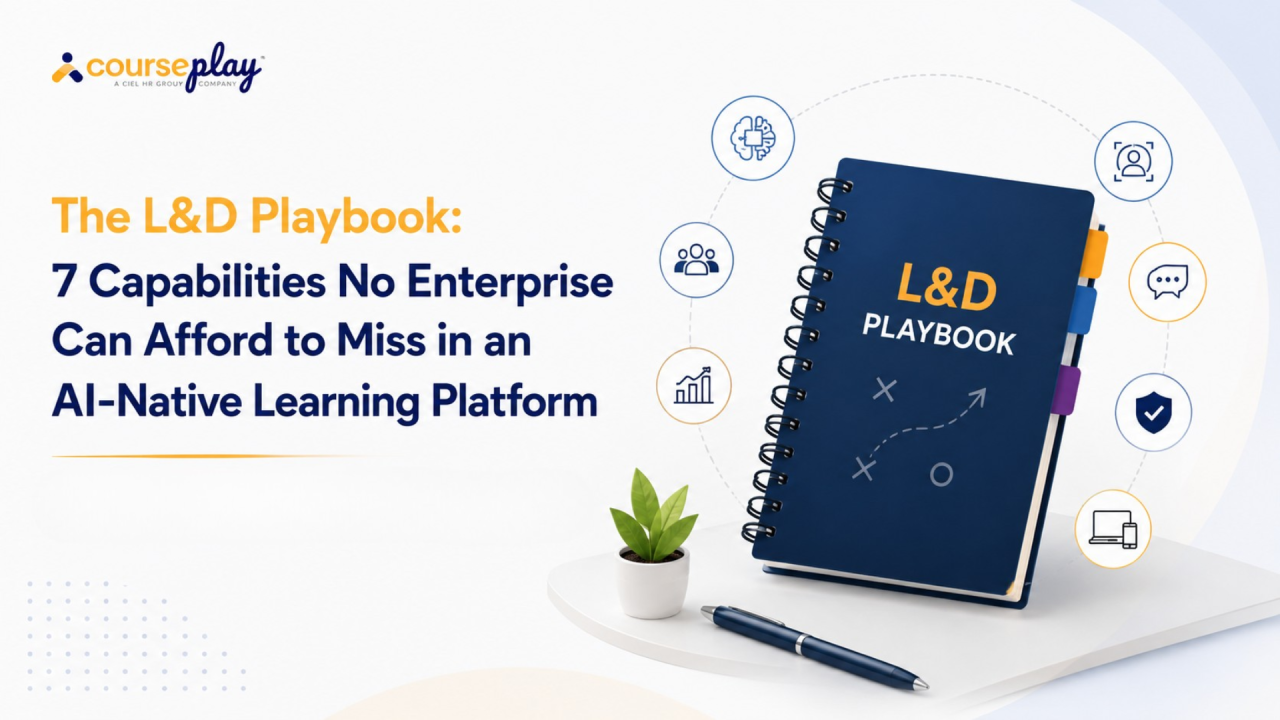
The global learning ecosystem is undergoing a structural reset. What began as digital enablement has accelerated into a full-scale redesign of how organizations build, deploy and sustain capability at speed.
Most learning platforms in use today were designed for a different era: stable roles, predictable skill requirements and episodic training cycles. In a world of fluid work, compressed strategy cycles and continuous skill disruption, these systems create blind spots leaders can no longer afford.
Multiple global signals already point in this direction:
- The WEF’s Future of Jobs Report projects that about 39% of core job skills will change by 2030, illustrating rapid skill disruption that outpaces traditional reskilling cycles.
- High-performing organizations are investing in AI-led workforce intelligence rather than standalone learning tools
This convergence has given rise to AI-native learning platforms designed not to manage learning activity but to function as enterprise capability intelligence infrastructure.
The 7 Core Capabilities of AI-native learning platforms:
1. Capability Intelligence & Continuous Skill Gap Identification: By 2026, static competency frameworks will be structurally incompatible with modern work. Traditional role-based models assume stability, clearly defined jobs, predictable progression and linear skill acquisition.
In reality, work has become contextual, project-driven and continuously reconfigured. As work evolves, skill gaps emerge dynamically varying by project, business priority and timeframe.
Next-generation AI learning platforms address this by continuously identifying skill gaps. By analyzing signals from work outputs, learning behavior, performance data and market intelligence, these systems surface where capabilities fall short, where they are emerging, and where intervention will deliver the highest impact.
For leadership, this enables a shift from reactive training to proactive capability building, closing critical skill gaps before they impact execution and deploying talent with precision to the areas that matter most.
2. Knowledge Liquidity & Institutional Memory Systems: One of the most underestimated enterprise risks today is knowledge decay. As workforce mobility increases, tacit operational knowledge of how things actually get done continues to walk out the door. Traditional knowledge management systems fail because they rely on deliberate documentation, which rarely reflects real work.
Any AI LMS that does not function as an institutional memory system will create systemic knowledge risk. Not merely storing documents, but continuously ingesting, structuring and surfacing knowledge embedded in conversations, decisions, project retrospectives and informal problem-solving.
The outcome is knowledge liquidity where expertise becomes accessible, transferable and compounding rather than fragmented and fragile.
3. Predictive Workforce & Performance Intelligence: Most learning analytics today remain retrospective. They explain what happened but offer limited guidance on what is likely to happen next.
AI-native learning platforms shift the lens from reporting to prediction. By correlating capability signals with performance outcomes, these systems surface early indicators of execution risk before they manifest as missed targets, quality issues, or customer impact.
Leaders will increasingly rely on:
- Readiness scores for strategic initiatives
- Early warning signals for capability gaps
- Learning data becomes a forward-looking management input not a historical HR report.
4. Automated Learning Operations & Orchestration: At scale, learning programs often struggle not because of intent or content quality, but due to operational overhead, manual tracking, follow-ups and inconsistent learner communication.
Next-generation learning platforms address this by automating routine learning operations such as assignment distribution, reminders, progress tracking and basic follow-ups. These capabilities help ensure learners stay informed and programs stay on track, without requiring constant manual intervention from L&D teams.
This shifts learning from being managed as isolated programs to being supported as an ongoing operational process more reliable, easier to scale and better aligned with day-to-day work realities.
5. Natural Language Interfaces, Voice Assistants & AI Learning Assistants: The primary interface of an LMS will increasingly move beyond dashboards to conversations across text and voice.
Employees and managers will expect to access organizational knowledge using natural language, whether by typing a question or speaking it and receive contextual guidance at the moment of need. Voice-enabled assistants make learning more accessible in hands-busy or time-constrained environments, complementing text-based interactions rather than replacing them.
These assistants function as practical decision-support tools helping users find relevant information, clarify processes, and apply learning in context, not just navigate courses. This represents a shift from traditional “training delivery” toward judgment augmentation and on-demand capability support.
6. Learning in the Flow of Work: The separation between work and learning is already eroding and by 2026, it will be untenable. Next-gen platforms embed learning interventions directly into operational systems, CRMs, collaboration tools, and execution environments. The result is a continuous performance layer, where capability improves through action, not interruption.
7. Outcome-Linked Learning ROI & Value Attribution: Boards are no longer satisfied with activity metrics. Learning platforms that cannot provide a clear line of sight between capability and outcomes will lose credibility at the board level.
AI-native learning platforms enable this through sophisticated attribution models that correlate learning signals with real performance data. This elevates L&D from a support function to a value-creation engine.
Strategic Impact on the Enterprise
When these capabilities operate as a cohesive system, the impact goes far beyond learning. Talent strategy becomes adaptive, with capability data informing deployment decisions in real time. Market response accelerates because skill readiness is continuously aligned with strategic priorities. Execution risk declines as capability gaps are identified before they manifest operationally.
The AI-native learning platform evolves into a strategic control system, orchestrating the flow of capabilities across the enterprise. Think of it as a capability supply chain: ensuring that the right skills are developed, mobilized and sustained where and when they matter most. Over time, this transforms workforce development from a reactive function into a source of competitive advantage, enabling organizations to adapt faster than competitors constrained by static, inflexible learning infrastructures.
By 2026, the LMS will be less about courses and more about intelligent capability orchestration directly influencing business outcomes, execution speed and organizational resilience.
Future Outlook: 2026–2030
Looking ahead, the convergence of learning, performance and talent intelligence will be absolute. AI agents will no longer simply recommend content, they will actively manage team development in real time, nudging capabilities where they are most needed.
The LMS of the future becomes a “Digital Twin” of the organization’s human potential, enabling leaders to simulate scenarios:
- How will a skill gap in a critical team affect market share?
- What happens if key talent moves or roles are restructured?
- Which capability interventions yield the highest ROI?
The boundary between “managing the business” and “developing the workforce” will effectively vanish. Leaders will rely on their AI learning platforms not just to train employees but to continuously shape the organization’s ability to execute and innovate.
Conclusion
The evolution of the LMS is no longer just a technology story, it is a strategic one. Enterprises confronting accelerating change, skill disruption and rising execution complexity will see their learning infrastructure choices directly shape organizational relevance.
Next-generation AI learning platforms are defined not by features, but by their ability to function as intelligence systems for capability development. Leaders who view them merely as operational tools will miss their strategic significance. Those who reassess learning investments through the lens of enterprise resilience, agility, and performance will position their organizations to thrive in an environment where adaptability is the ultimate differentiator.
The decisions made today about learning architecture will determine not just how employees learn, but how effectively the enterprise itself evolves.
Follow us here on LinkedIn and subscribe to our newsletter, Learning Loop, for more insights and ideas on transforming learning into business impact.
From Learning Management to Learning Intelligence Layer: What the Next Generation of Learning Infrastructure Actually Looks Like
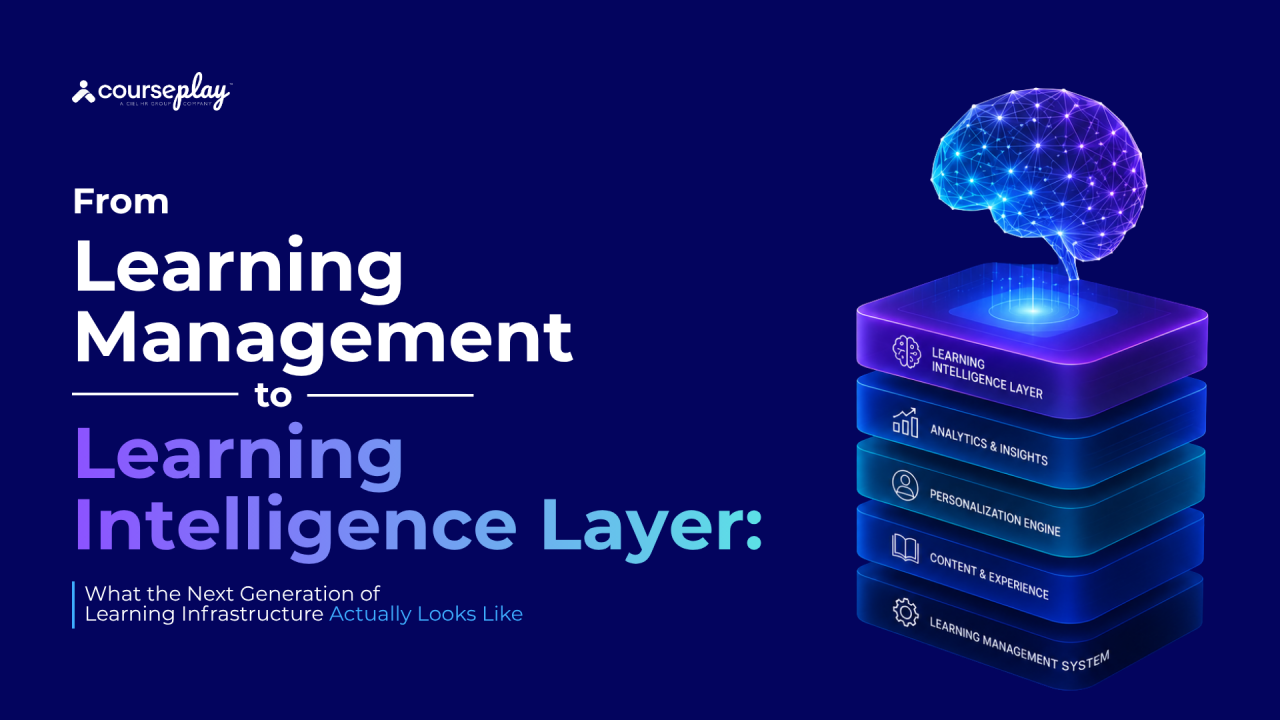
The LMS was built to store and deliver learning. The Intelligence Layer is built to act on it. These are not the same thing and confusing them is costing organizations more than they realize.
Every technology category evolves as business needs become more complex. The spreadsheet evolved into the database. The database evolved into the data warehouse. The data warehouse evolved into the intelligence platform. Each stage built on the previous one while expanding what the organization could achieve.
Workplace learning is at exactly that moment right now.
The Learning Management System, the platform category that has anchored corporate L&D for three decades, was designed to solve a specific problem: how do you deliver training content to a large number of people and prove that they completed it? It solved that problem well. Courses were assigned. Completions were tracked. Compliance boxes were checked.
The LMS remains the operational foundation of workplace learning. But the problem organizations are trying to solve in 2026 is fundamentally different. It is no longer just “How do we deliver content at scale?” It is “How do we build a more capable workforce continuously, measurably and in direct response to business needs?”
That’s not simply a content delivery challenge. It is an intelligence challenge.
Solving that challenge requires learning platforms to evolve beyond administration and tracking toward systems that can interpret signals, automate actions and continuously connect learning with performance. This is where Agentic AI becomes transformational, not as another feature, but as a new operating layer for workplace learning.

What an Intelligence Layer actually does differently
The term gets used loosely, so it is worth being precise. A Learning Intelligence Layer is not an LMS with AI features bolted on. It is a different architectural philosophy, one built around the idea that a learning system should read, respond, and act on real signals from the organization, continuously and autonomously.
In practice, that means four fundamental shifts in how the system works:


What this means for how organizations buy L&D technology
The buying criteria for an LMS and a Learning Intelligence Layer are fundamentally different. While LMS capabilities such as content management, compliance tracking and administration remain essential, organizations are increasingly evaluating platforms on their ability to connect learning with workforce capability, performance outcomes and business priorities.
The right questions to ask a learning platform in 2026 are not about features. They are about architecture and outcomes.

What this means for how organizations build L&D strategy
The shift from LMS to Intelligence Layer is not just a technology decision. It changes how L&D teams should think about their own role.
In an LMS world, L&D’s primary job is content production and program management, building courses, running workshops, managing enrollments, and reporting completions. These are coordination activities. Valuable in their time, but increasingly automatable and increasingly disconnected from the business outcomes leadership actually cares about.
In an Intelligence Layer world, L&D’s primary job becomes something entirely different: defining what capability the organization needs to build, setting the conditions for continuous development, and interpreting the signals that the system surfaces. The coordination work is handled by agents. The strategic work is handled by humans. That is a more valuable and more sustainable position for the function to occupy.
The L&D teams that will matter most in the next five years are not the ones that build the most content. They are the ones who build the most intelligent learning infrastructure

What this means for how organizations measure L&D
Measurement is where the gap between LMS thinking and Intelligence Layer thinking is most visible and most consequential. Because what you measure determines what you invest in, what you optimize for, and what you can defend to a CFO when budgets are under review.

These metrics often require learning platforms to be integrated with performance, skills, and workforce data systems. Traditional LMS reporting alone may not provide this level of visibility. All of them are available in a Learning Intelligence Layer because the system is connected to the data that generates them and the agents that surface them automatically.
The transition is already underway
The organizations at the leading edge of this shift are not waiting for the perfect moment. They are making the transition incrementally starting by connecting their learning system to their performance management data, then expanding the surface area from which the system reads signals, then progressively automating the coordination activities that currently consume their L&D team’s time.
The starting point is less important than the direction. The question is not whether your organization will eventually operate with a Learning Intelligence Layer. It is whether you build the infrastructure now, while it is still a competitive advantage or later, when it is table stakes.
The LMS remains the foundation of enterprise learning. But as organizations seek measurable capability growth and AI-driven workforce development, the role of the LMS is expanding beyond content delivery into an intelligent system of action. The organizations that recognize that earliest and rebuild their learning infrastructure accordingly will develop workforces that are faster, more capable, and more adaptable than the ones still running on a system designed for a different century.
Courseplay combines the strengths of a modern LMS and LXP with the intelligence capabilities organizations increasingly need. By bringing together Agentic AI, skills intelligence, automation and performance signals, organizations can move beyond managing learning and begin accelerating workforce capability at scale.
That means connecting learning to performance signals, building the measurement infrastructure that actually captures capability change, and shifting your L&D team from coordination to strategy.
If you are evaluating learning infrastructure for 2026 and beyond, the conversation starts with architecture, not features.
One Language Is Not Enough: The Business Case for Multilingual Training at Scale
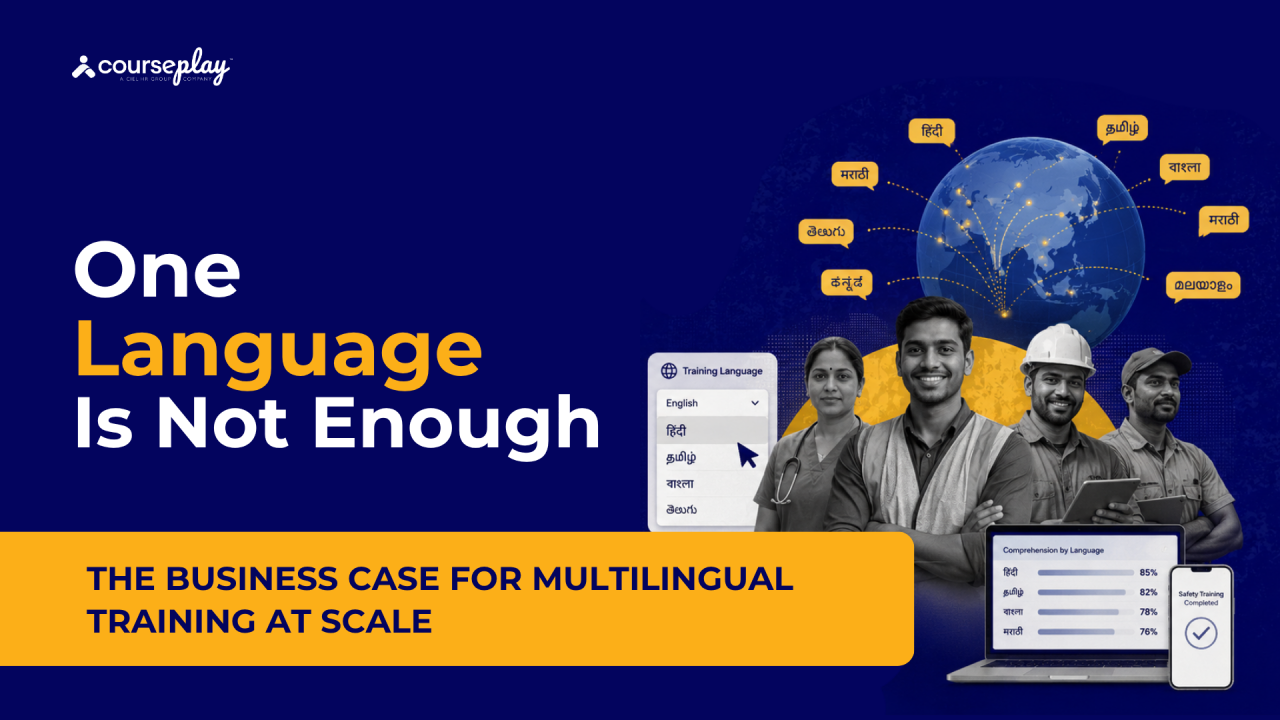
Why delivering training only in English is a compliance risk, a safety hazard and a retention problem and what to do about it.
India alone has 22 official languages. Most corporate training has one.
India’s Constitution recognises 22 official languages. Across manufacturing plants, retail stores, warehouses, hospitals, logistics hubs and hospitality operations, frontline workforce often works in languages far removed from the language of corporate training. For millions of workers, English is not the language in which they process instructions, absorb safety procedures, or build confidence on the job.
And that creates a serious business problem.
Across India’s frontline workforce, employees routinely operate in Bengali, Tamil, Telugu, Kannada, Marathi, Gujarati, Malayalam, Odia, Punjabi and several regional dialects. Hindi and English may dominate corporate communication, but for a significant portion of frontline employees, neither is the language in which they naturally learn and apply complex information.
The challenge extends beyond India. Across Southeast Asia and the Middle East, multilingual workforces have become the operational norm. A warehouse in Dubai may employ workers from Kerala, Karnataka, Bangladesh, Nepal and the Philippines, multiple first languages within the same shift.
The business reality is straightforward:
If employees cannot fully understand their training, they cannot fully apply it. And if they cannot apply it, the training investment has failed, regardless of what the completion dashboard shows.

The languages your frontline employees actually speak
For organizations operating across India and the broader South Asian region, the primary languages present in a frontline workforce typically include:

This is not a corner case. For any organization operating manufacturing, retail, logistics, or healthcare operations in India, a workforce spanning at least three to five of these languages is the norm, not the exception. Training in English alone reaches a fraction of them at full comprehension.
The real cost of language-barrier training: compliance, safety and productivity
The consequences of delivering training that employees cannot fully understand fall into three distinct categories, each with a direct business cost.
1. Compliance and legal exposure
Providing training is not the same as ensuring comprehension. Regulators increasingly enforce this distinction. OSHA mandates that employees must receive training in a language they understand, not merely in the language chosen by the employer. Workplace injury cases involving language barriers settle for two to three times higher amounts. Compliance violations are measurably more frequent at sites where training is delivered only in the dominant corporate language.
2. Safety incidents and operational errors
Language barriers are a contributing factor in approximately 25% of job-related accidents. In high-risk environments, such as manufacturing lines, chemical handling, food processing, cold chain logistics, the gap between reading a safety procedure and truly understanding it can be the difference between operational safety and serious incidents. Misunderstood procedures also produce higher error rates in quality-sensitive operations, rework costs and regulatory scrutiny.
3. Slower productivity and higher attrition
Multilingual teams take measurably longer to reach full productivity when training is not localized. When a new hire spends their first weeks processing content in a language they cannot fully understand, the time-to-productivity cost is real. Attrition is equally affected: employees who cannot access development in their own language are more likely to disengage and leave. For frontline operations where attrition is already a primary cost driver, this is a retention lever hiding in the L&D function.
Google Translate is not a multilingual training strategy
Many organizations attempt to solve the multilingual challenge with free translation tools. This is understandable and genuinely risky. Word-for-word translation of technical content, safety procedures, or compliance language produces material that is grammatically approximate but contextually unreliable. Technical and legal terminology is frequently misrendered in ways employees cannot detect; they receive content that reads fluently but communicates something materially different from the original.
The correct standard is not just translation; it is localization. That means translation by subject-matter-literate linguists, review by in-country HR or legal professionals and cultural adaptation of scenarios, imagery and examples. AI-assisted localization tools within a purpose-built LXP platform make this feasible without the budget of a traditional translation agency.
Translation converts words. Localization converts meaning. Only the second one changes behaviour on the shop floor.
How to build a multilingual training programme that actually works at scale
The operational challenge of multilingual training at scale is real but it is a solved problem for organizations with the right platform infrastructure. Here is the framework that works.
Audit your workforce’s languages first. Before building content, map the primary languages present in each operational location at the site level, not the organizational level. A factory in Coimbatore and a warehouse in Gurugram have fundamentally different language profiles.
- Prioritise by risk, not by convenience. Safety-critical and compliance-mandatory content should be localized first. Begin with content where a language gap has the highest potential for harm or legal exposure. Onboarding modules and SOPs for high-risk processes belong in this category.
- Use AI-assisted localization, not free translation. A modern LXP platform with built-in multilingual capabilities can generate and manage localised content at a fraction of traditional cost. Human review at the localization stage remains essential – particularly for safety and compliance content.
- Set language as a learner attribute, not a content variant. Training should appear in the learner’s registered language automatically, not require workers to locate an alternative version. This eliminates the scenario where an employee completes English content because they cannot find the Hindi version.
- Measure comprehension by language group, not just overall completion. Track assessment scores, retake rates, and post-training incident data by language group. This reveals which translations are working, which are not, and provides the audit trail needed to demonstrate genuine effectiveness to regulators and insurers.
- Update all language versions simultaneously. When source content is updated, all localised versions should be updated in the same release cycle. Staggered updates create periods where some language groups are training on outdated content – an audit and safety risk.
The regulatory and market direction is unambiguous
Across global markets, the regulatory direction is consistent: training must be delivered in a language employees can understand, and organizations must demonstrate comprehension, not just completion.
In India, the Factories Act, the Food Safety and Standards Act, and sector-specific regulations for healthcare and logistics all require that safety and compliance instructions be communicated in a manner workers can genuinely understand. As enforcement mechanisms mature and digital audit trails become standard, “we provided training” will give way to “we demonstrated that workers understood their training.”
Organizations that invest in multilingual training infrastructure now are not just solving a current compliance gap. They are building the audit capability, the safety record and the employee trust that will differentiate them as this regulatory direction firms up over the next two to three years.

Start here: before the next audit, the next incident, or the next hire cohort
- Run a language audit at your two largest sites. Ask operations managers to list the five most common first languages in each location. Map that against the languages your training is currently available in. The gap is your immediate priority list.
- Pull your assessment scores by location. Sites with large multilingual workforces and below-average assessment scores are almost certainly experiencing a language comprehension gap, not a motivation gap. This reframes the conversation from “our workers aren’t engaging” to “our training isn’t reaching our workers.”
- Ask your LXP or LMS vendor one question: “How does our platform handle multilingual content delivery, learner language preferences and per-language completion and assessment tracking?” If the answer requires a significant manual workaround, you are operating on infrastructure that was not built for your workforce.
Sources:
https://www.babbelforbusiness.com/us/blog/the-true-cost-of-manufacturing-safety-incidents-caused-by-language-barriers/
https://www.legislative.gov.in/constitution-of-india
https://relaypro.com/blog/hidden-costs-of-language-barriers-in-industrial/
The Skills Paradox: Why Your People Are Learning More But Performing the Same
Your organization invested in a new learning platform last year. Completion rates climbed. Learner satisfaction scores looked good. Leadership celebrated the numbers at the quarterly review. And then… nothing changed.
Not the sales conversion rates. Not the quality metrics on the floor. Not the speed at which new managers transitioned into their roles. The learning happened. The performance did not follow.
This is what we call the Skills Paradox and it is quietly costing organizations far more than they realize.

The problem is not that organizations are ignoring learning. It is that they have been measuring the wrong indicators of success.
Optimized the Wrong Metric
The uncomfortable truth is that the L&D industry spent two decades perfecting the art of course completion, building platforms that made it easy to assign, track, and report on training, celebrating 100% completion rates in all-hands meetings.
But completion is not a performance metric. It is an activity metric. A finished course is not a developed skill. A certificate is not evidence of readiness. The moment we started treating these as proxies for growth, we began building a house of cards.
“Learning that lives only inside a platform has no business value. It needs to travel into conversations, into decisions, into the work itself.”
– A reality every L&D leader knows but few platforms are designed around
And this disconnect becomes even more visible once learning leaves the platform and enters the real world of work.
The Transfer Problem Nobody Talks About
Learning science has known about the transfer gap for decades. Research consistently shows that the majority of what people learn in a formal training context does not make it back into daily work behavior. Not because employees are disengaged. Not because the content was poor. But because learning and working have been treated as two separate activities that happen at two separate times.
Think about the last compliance training your organisation ran. Employees completed it in a focused session, often under deadline pressure, knowing they needed to hit a passing score. Two weeks later, when a real situation arose that required applying that knowledge, the learning was already fading. There was no reinforcement. No contextual trigger. No one connecting the dots between what was taught and what was needed. This is not a people problem. It is a design problem.
So why does this gap continue despite growing investments in learning?
Three Reasons the Paradox Persists
Where the gap actually lives
- Learning is event-based and not continuous. Most organizations still think of training as a discrete event, a course, a workshop or an induction week. But capability is built through repeated exposure, practice, and feedback over time. One-time learning events create short-term recall, not long-term behavior change.
- Content is standardized, not personalized. When everyone gets the same learning path regardless of their role, experience level, or performance gaps, most of what they receive is either already known or irrelevant to their current challenges. Personalization is not a luxury. It is the difference between learning that sticks and learning that is forgotten by Friday.
- There is no feedback loop between learning and performance. In most organizations, the L&D system and the performance management system are entirely disconnected. Learning does not know what the performance system is flagging. The performance system does not know what learning has happened. And so the two operate in parallel, never informing each other, never closing the loop.
Fixing the Skills Paradox does not require more content libraries or longer learning paths. It requires rethinking how learning is designed and delivered.
What Closing the Loop Actually Looks Like
The organizations escaping the Skills Paradox are not necessarily spending more on learning. They are designing learning differently. They embed learning into the flow of work instead of pulling people away from it. They connect skill development directly to performance signals and make learning continuous rather than episodic.
Instead of assigning a leadership course to a new manager and hoping it takes, they are identifying specific behavioral gaps through performance data and serving targeted, contextual nudges at the moment they are most relevant. Instead of a six-hour compliance module, delivering two-minute refreshers tied to real workflow triggers.
More importantly, they are measuring what actually changed – not what was completed.
The shift is from learning management to learning intelligence. It is not about delivering more content. It is about delivering the right capability, to the right person, at the right moment.
But delivering this level of contextual, continuous learning at scale is nearly impossible through manual systems alone.
The Role of AI in Breaking the Paradox
This is where artificial intelligence moves from buzzword to genuine business lever. When learning is connected to performance signals, career data, and real-time behavior patterns, AI can do something no manual process ever could: identify the exact gap between where someone is and where they need to be, and close it intelligently.
Not by assigning more courses. By recommending the precise learning ingredient – a scenario, a coaching prompt, a piece of social learning from a peer – that addresses the specific gap, at the exact moment it matters most.
This is what capability intelligence looks like in practice. And it is what separates organizations that are merely spending on learning from those that are actually building a more capable workforce.
A Question Worth Sitting With
If your organization ran zero formal training next quarter but kept all its performance coaching, on-the-job feedback mechanisms, and peer learning systems intact – how much performance impact would you actually lose?
For most organizations the honest answer is uncomfortable. And that discomfort is the starting point for building something better.
The Skills Paradox is not inevitable. It is a design choice that can be unmade. The question is whether your learning strategy is built around activity or around impact.
The organizations that solve this challenge first will not just build stronger learning cultures. They will build stronger businesses.
At Courseplay, we believe the future of L&D is not more learning, it is smarter learning. Learning that knows where your people need to grow, meets them in the flow of work, and connects directly to the outcomes your business cares about.
Follow Courseplay and Subscribe to the The Learning Loop Newsletter for more insights on workforce transformation and L&D strategy. Sources
Association for Talent Development (ATD) – Only 12% of employees effectively apply new skills learned in training back to their jobs. https://www.shiftelearning.com/blog/factors-that-affect-the-transfer-of-training
Middlesex University Institute for Work Based Learning – 74% of employees feel they aren’t reaching their full potential at work due to lack of development opportunities. https://www.shiftelearning.com/blog/statistics-on-corporate-training-and-what-they-mean-for-your-companys-future
eLearning Industry – The global workplace training market reached $401 billion in 2024, reflecting sustained growth in corporate L&D investment. https://elearningindustry.com/employee-training-statistics-trends-and-data