Get a Free Trial

Making the Transition to Innovative Agile Training

Today’s fast-paced and ever-evolving business landscape requires organizations to embrace innovation and agility to remain competitive. Thus, companies are increasingly migrating from conventional, sequential “Waterfall” approaches to Agile iterative frameworks in order to outperform and outwit the competition.

Agile training can be used to foster innovation within an organization. These methodologies can reduce time to market, encourage greater creativity, enhance customer experience, and raise product quality. However, the transition from Waterfall to Agile is not easy. Taking these three crucial recommendations into account may help businesses avoid the rocky transition from Waterfall to Agile.

1. Invest In Training:

According to a Forbes and Scrum alliance poll, the largest skeptics of organizational agility are long-term employees. Remarkably, 29% are content with their existing employment and are adamantly opposed to change. However, correct training may aid in the formation of a new perspective. Extensive training is required for the participants to grasp the Agile Manifesto, Agile principles, and other practices. In order to reduce tensions and demonstrate how Agile helps workers, organizations could introduce employees to value-driven development and Agile approaches such as Scrum.

2. Develop a Solid Communication Structure:

In a Forbes Insights and Scrum Alliance poll, 81% of respondents cited communication with all stakeholders as the most important factor in a successful Agile transition. As part of this communication, the C-suite speaks to staff about the benefits of Agile and emphasizes why it is worthwhile to overcome the discomfort of change.

3. Acquire Third-Party Assistance:

Almost two-thirds of CEOs have employed a third-party consultant to assist their firm in becoming more Agile. As Agile coaches, they can provide in-depth knowledge of Agile practices and methodologies such as Scrum. In addition to technical knowledge, the right third-party provider should understand organizational change and have real-world experience with actual Agile transformations. They should be able to bring in a perspective that can assist organizations in determining their own path, approach, and solutions for migrating from Waterfall to Agile.

To summarize, transforming an organization into an innovative and agile one requires well-designed and executed training. By understanding the above recommendations, businesses can easily smoothen the transition and improve acceptability for faster results. Agile training is an ongoing investment, as it enables individuals and teams to adapt, collaborate, and thrive in today’s rapidly changing world. Training programs are the key to staying ahead in the competitive landscape and delivering value to customers in an innovative and efficient manner.

Implementation Best Practices

DESIGN AN IMPLEMENTATION STRATEGY

  • Get the right team members on board
  • Gather their feedback
  • Ensure that you are willing able to ultimately deploy the solution you purchase

PREPARE YOUR TEAM FOR DEPLOYMENT AND ADMINISTRATION

  • Assemble a small group (5 or 6 people) that will work on the implementation. These individuals will oversee the administration, technical support, and content management of Courseplay
  • Appoint one person to act as the team leader or single-point-of-contact (SPOC), and another to create a training strategy once Courseplay has been deployed and tested. This team may also include those who help out and serve as advisers on an occasional basis, such as those who use the training system frequently or content creators
  • Usually, organizations will have several people managing the different sectors of the platform. Courseplay allows you to add and modify new user types with unique rights and permissions to make sure that each person has access to everything they need to monitor, whether that is reports, content management, administrative rights and moderation of assignments. Clients sometimes choose to assign a person for each branch in order to have a person responsible over a segment of their training system as a whole, or simply to monitor some specific information over that branch

FORMULATE A COURSEPLAY IMPLEMENTATION TIMELINE

  • Leave sufficient time in the schedule for the Courseplay implementation itself and for problem solving
  • Leave room to get rid of any glitches or address any concerns that may crop up during the deployment phase

DEFINE EXPECTATIONS WITHIN THE TEAM

  • Honest and clear communication between members, to avoid ambiguity in the goal setting process
  • Trust between team members so tasks can be completed without excessive micromanagement

ENSURE YOUR IMPLEMENTATION PLAN WORKS FOR YOUR NEEDS

  • The implementation plan must be flexible to accommodate for new requirements over time. Prepare a list of the all of the tasks that need to be wrapped up during the process
  • Provide any other settings and configuration information that will be pertinent to the deployment of Courseplay using the configuration checklist provided (separate attachment)
  • Specify user profiles, security settings for Courseplay, along with administrator roles, and course structures you will be using

DEFINE EXPECTATIONS AND GOALS FOR COURSEPLAY

  • Include any organizational concerns that Courseplay should address, and objectives that you hope to achieve via the platform
  • Focus on areas of the training system that are higher in priority and ensure that Courseplay is fulfilling its primary purposes

KEEP THE CONTENT READY

  • Not all overnight but basic content gradually
  • Ensure that you have a good amount of content on-hand, so that you can ensure the system is going to serve its primary purpose
  • If you don’t already have a content creation team, then you’ll want to find a content developer who can curate and manage the data within Courseplay
  • Each department within your organization should have a hand in the content that is being integrated into Courseplay

GET ACQUAINTED WITH COURSEPLAY

  • Schedule a basic training session. Be sure to get your training completion certificate once training has completed. In case of a large-scale roll-out, an intermediate course may be needed
  • We use a knowledge base of helpful articles, tutorial videos, our support page and blog to keep in touch with our clients and adapt to the needs of our users which grow alongside the platform

COMMUNICATION AND REGULAR UPDATES

  • Every member of your staff who will be either using or benefiting from Courseplay should have the opportunity to take part in the deployment process
  • Communication is an essential tool both between learners, learners and teachers, as well as administrators and developers in order to drive change where and when it’s needed the most and to make sure the project is running smoothly and on time

DATA MIGRATION (IF ANY)

  • If you already have a Learning Management System (LMS) in place, then you will need to migrate the data to Courseplay. In some cases, data may have to be migrated from an older version of Courseplay to the latest one
  • This must be done in a particular order, so you’ll want to involve both the IT team from your organization and those from the Courseplay support team, in order to ensure that it goes as smoothly as possible
  • Only move the training data that you absolutely need. Migrate your user information and profiles, courseware, the course data, and transcript data

EMAIL PREPAREDNESS

  • Emails are a critical component of Courseplay. For Courseplay to work correctly, two things must be done:
  1. The correct email addresses must be uploaded for all users. If this is not done correctly, email verification will fail and the user will not be able to log in.
  2. The client-side email server must allow emails from the courseplay.co domain. In some cases the domain must specifically be white listed.

TEST COURSEPLAY BEFORE IT GOES LIVE

  • You’ll want to verify that Courseplay works as per your expectations by performing a User Acceptance Test (UAT)
  • Act as though you are the user, and carry out a variety of tasks within the system to ensure that everything goes according to plan
  • Write down all of the functions and processes that will typically be performed within the system by the user and assign a team to test out these specific functions
  • Share feedback and any glitches that come across during the test with our support team (support@courseplay.co)

CONSIDER A SOFT LAUNCH

  • In case of medium-to-large roll-outs, consider launching with between 10 and 50 users first for two weeks before rolling out to the entire organization
  • Record all feedback and share updates with the Courseplay support team

GO LIVE!

Our team will stay with you for the pre-defined hyper-care period. Clients typically only need hand-holding for a couple of weeks before becoming Courseplay masters.

360-degree employee growth with the 70-20-10 principle

In March 2020, just before Covid-19 was announced my team and I were introduced to a tech startup in Gurgaon, India with a problem. This company sold high-value products to a large consumer market in India. They had a sales team of 1500 across the country with 40 trainers that would visit each branch and train new joiners in a classroom format. Unfortunately, training completion rates were consistently less than 30% and employee pulse surveys frequently reported that employees were disengaged and demotivated.

In December 2021, the same company announced that they were one of the top 50 Great Places to Work in Asia. Training completions were now above 85% for 3 months straight, employee satisfaction was at an all time high and attrition at an all-time low against industry benchmarks despite the great resignation.

So how did they do it? This post is about three numbers: 70, 20, and 10, and a 40-year-old idea that will define the next decade of L&D. Let’s take a deeper look!

What does 70-20-10 mean?

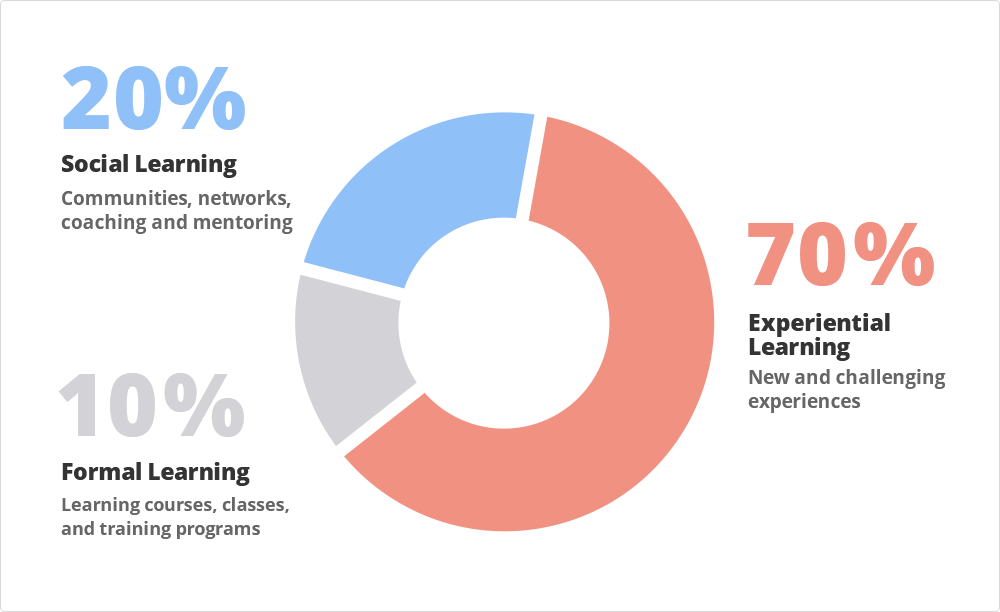
‘10’ means that 10% of an employee’s experience in the company comes from formal learning interventions and planned training. These are the facts, figures and foundations of learning. Online and classroom training, ILTs, VILTs, WBTs, mobile learning, game-based learning all come here. This is an essential part of the learning journey but there is more.

Next is 20. 20% of an employee’s experience in the company derives from social learning, or working with others. Reporting managers, mentors, coaches and peers play an important role in the employee growth experience in the company. Learning doesn’t happen in isolation. We learn by sharing knowledge and observing others.

And thirdly, 70. 70% of the employee experience comes from on-the-job experience, experimentation and reflection. “Learning in the flow of work” is a buzzword we frequently hear has to do with finding the right resources while employees are working on new tasks they have never worked on before. “On the job learning” means learning from daily problems and challenges that an employee may encounter. People learn the best by doing and the key idea here is that learning is more effective the closer it is to the point of use.

Learning is more effective the closer it is to the point of use

Our tech startup friends had their trainers go from branch to branch, completing the curriculum they were assigned. The focus of this company was only on the 10% and not the entire 100% of the employee growth journey. 90% of the learning was not measured by their management!

The truth is that this could be any company and the story is the same everywhere. Current employee learning programs only touch on 10% of the employee experience, and 90% is untapped. Activities like behavioral scorecards, mentorship, coaching and on the job learning should be embraced to provide a fuller employee experience in the company.

A big shift is coming

There has been a big shift in the way companies manage their teams. With the great resignation there has been a tremendous pressure to offer employee growth options to retain employees. Managers have become more like coaches and cheerleaders for their subordinates. With remote working at an all-time high, managers are ensuring their teams have what they need to get the job done. That might not just be resources in the form of software, tools and training, but also in the form of professional guidance, counselling and motivation.

Learning is a complex and nuanced idea. Next generation learning platforms must now also capture multiple dimensions of data if they are to provide accurate recommendations to their business teams.

So how can we embed learning in the flow of work into the company? In the next post we will see 10 ways to implement the 70-20-10 principle in the workplace. Stay tuned!

Automating the Employee Experience: 4 Opportunities and 3 Challenges

The COVID-19 pandemic has fast-tracked the pace of digital transformation for enterprises in practically every industry. As per a McKinsey report from October 2021, companies have been pushed over the technological tipping point which has transformed businesses and the way we work forever. Organizations are moving towards automation not just to deal with their external customers but also their internal ones i.e., their workforce. Automation is being used to enhance the employee experience and job satisfaction.

What can Automation Achieve?

The word automation may bring to mind images of robots working on assembly lines but for an enterprise, that isn’t the case. Automation can be used to streamline critical business processes like organizing and filing paperwork, sending standard notices, maintaining and validating data entered by customers, tracking orders and filling out routine paperwork. All of this and more is achieved without the risk of human error.

There is little debate over the fact that when done right, automation increases the speed, efficiency and accuracy of an organization’s internal processes. By automating routine and mundane tasks, the human capital can focus on strategic thinking and intellectual pursuits. Employees can be free to execute tasks that are creative in nature which leads to greater employee engagement and increased productivity.

Other Benefits

Automation has other benefits as well. By digitizing the manual paper pushing tasks, it increases the options for remote work for employees, without any significant impact on business. It can also provide increased visibility and accountability into work processes. With automation, people may not need to spend hours chasing information and approvals that they need to do their jobs.

Automation can enable massive economies of scale by lowering the cost of production, especially for industries that require high capital investments. It can also enable economies of scope by allowing for greater product differentiation and customization.

Opportunities for Enterprises

Once focus intensive, mechanical tasks are automated, employees can spend their time addressing the mission-critical tasks rather than administrative work. Increased productivity and efficiency of the employees will have a direct bearing on creating better results for the business. Automation can also provide scalable solutions to engender a business that is agile and resilient. The business will be able to achieve more with less and have greater return on investments.

Automating will allow organizations to analyse their business processes and effectiveness. By tracking and collecting relevant data organization can discern patterns within the data and create reports and action items. Such data driven decision making can be used to create best practices for the organization and lead to better resource allocation.

Automating training processes can give organizations additional options to customize their employee growth journeys. It can ease the process of managing enrolment and selecting the right courses and to track key metrics and goals, both for the management and the trainees. The learning journeys can also be integrated with other business systems to create a seamless experience for the trainees

The Challenges

While automation provides multiple benefits to an organization, there are also challenges that must be addressed. In certain cases, requiring emotional intelligence and soft skills, use of automation may be limited. But many a times, organizations and people are simply unaware that such solutions exist and can be applied effectively for greater profitability. There is need for effective communication that demonstrates what automation can achieve.

Further, in order to be successful, automation needs to be more than just identifying a process and applying technology to execute it. The human angle must always be factored in by creating a platform with engaging content. Humans are creatures of habit and getting people to adopt new methods of working can be difficult. The key is to be consistent and for leadership to be supportive of such endeavours.

Final Thoughts

Automation is going to be a major trend in the coming years across all industries. It will lead to newer opportunities and has the potential to revitalize industries going through a downturn. It can be a means to achieve your business goals faster as long as there is clarity on where it works and where it does not.

About Courseplay

Courseplay is quickly becoming the preferred toll for enterprises to automate their learning workflows. Courseplay is an employee experience platform that focuses on on-the-job, social and formal learning in the workplace. Companies like Amazon, SpiceJet, Hyundai and Emami are managing their entire skill and talent development lifecycle on our unified talent experience platform and mobile apps. We recently closed our seed round with Inflection Point Ventures and are looking for aggressive growth in the enterprise market this year.

Features Offered

Career Planning, Learning Management, Performance, Leaderboards, Levels, Badges, Rewards and Recognition, Mentorship, Coaching, Training Needs Analysis, Onboarding, Training Recommendations, Task Management, Chatbot, and more!

Business Problems Solved

Automate the learning journey for all employees

Get better recommendations for training program assignment

Provide employees with the ability to chart their growth plan

Drive training outcomes with zero-touch across distributed geographies

Ensure employee safety in post-COVID workplace

Save cost and effort of training operations

Make better decisions to retain, promote and nurture talent
Managing the Transition to 360-degree Employee Growth

With a recent push from formal learning to 360-degree employee growth, many companies are struggling to understand how to manage this transition. A solid employee transformation plan requires cultivating a learning-friendly culture by fostering innovation and learning from mistakes. In this post we look at some approaches that can successfully drive the transformation from “corporate training” to “360-degree employee growth”.

Make Learning a Collaborative and Interactive Experience

Employees and learners must be active participants in the process of establishing a culture of continuous learning. You have to allow them to select the skills and information they wish to acquire and provide constructive comments to assist them in improving their learning experience.

Organizations must collaborate with existing or new online learning platforms to develop new content, curate the current content, and validate online courses and information, and provide a well-rounded learning experience for all learners.

Aim For Agility and Flexibility

The digital revolution of employee experience has increased the number of online platforms and service providers that provide different solutions with different approaches. Organizations must determine which of these platforms truly bring value to individual skill sets as well as the organization as a whole. Make sure the partners you choose are able to adapt to the changing needs of your organization and work with you collaboratively as a partner rather than just offer a platform with basic support.

Consider Learning as A Journey

Modern businesses view training and development as a continuous process with defined objectives and key performance indicators (KPIs). The learning process can be divided into smaller, more structured sections that make the content easier to absorb and apply. Because of the digitalization of training and development, there is now space for online training courses and skill development via reliable online platforms that are linked to performance targets and behavioural scorecards allowing for customized learning journeys.

Conclusion

Organizations around the world are transitioning from a process-oriented to a result-oriented organizational structure. Rather than depending on long-established processes, they now utilize real data to compare outcomes of different experiments and then choose the method that produces the best results. It’s time to identify and improve employee abilities in a personalized way through 360-degree employee growth made possible by the next generation of employee experience platforms.

CIEL Group acquires strategic stake in Courseplay, plans IPO in FY25

Mar 05 2024: HR solutions provider CIEL Group said on Tuesday it is expanding beyond India by acquiring a strategic stake in Courseplay, a Mumbai-based international learning experience platform.

CIEL plans to go public in the Financial Year 2025 (FY25) and the acquisition (the value of which was not revealed) will help it become a technology-led human resources solutions provider. Courseplay helps organizations to develop their employees’ skills and is a market leader in diverse sectors, said CIEL. It integrates on-the-job, social, and formal learning and is trusted by leading enterprises and startups. CIEL plans to strengthen its human resources technology by integrating Courseplay’s platforms like ProSculpt, HfactoR, Jombay and CielJobs.

“We are happy to welcome Courseplay into CIEL’s family. The acquisition is a pivotal step in our journey towards emerging as one of the most respected tech-led human resources solution providers in the world. With our sights set on an initial public offering in the Financial Year 2025, this strategic move reinforces our dedication to driving growth and innovation in the human resources space. Together with Courseplay’s artificial intelligence-powered platform, we are poised to transform the employee learning experience and elevate our position as the top player in the industry,” said K Pandiarajan, executive chairperson of CIEL Group.

CIEL said its human resources technology revenues increased by 64 percent in quarter three of FY25. “As we continue to focus on human resources technology and drive growth in this dynamic sector, the acquisition of Courseplay marks a significant milestone for CIEL. As the technology landscape is constantly evolving, so are the skills in demand. CIEL sees this as an opportunity to transform the talent landscape by facilitating upskilling across the globe,” said Aditya Narayan Mishra, managing director and chief executive officer (CEO) of CIEL HR Services.

Employees tend to stay longer in a company that fosters a culture of innovation and the use of cutting-edge technology. Other top factors valued highly include opportunities to upskill, access to high-end training and ample career development, according to a survey by the Mumbai-based Courseplay, an international learning experience platform of the CIEL HR Group.

Arjun Gupta, founder and CEO of Courseplay, said: “Today marks a momentous occasion for Courseplay. Since our founding, we have been dedicated to revolutionizing the learning and development industry, and I am incredibly proud to announce that Courseplay is being acquired by CIEL. This is a natural next step in our journey, one that will allow us to amplify our impact on a global scale.”

Read more at: Business Standard

Additional Links: The Hindu Business LineYOURSTORYTimes of India

Scaling Learning for 18,000+ Employees_ How a Leading Global Organization Migrated from Moodle to Courseplay for a Unified Learning Experience


Use Case

Upskilling

Industry

Information Technology

Company Size

1,000 +

Bridging Skill Gaps in Emerging Technologies: How a Leading IT Services Company Enhanced Employee Training with Courseplay

Overview

A leading IT services company with a global workforce of 1,500 employees sought to use Courseplay to train their employees. The company faced challenges in upskilling its employees to meet the rapidly evolving demands of the technology industry.

Challenges

Skill Gaps

The company was unable to identify skill gaps in its workforce. Employees were working on emerging technologies such as cloud computing, artificial intelligence, and cybersecurity.

Inefficient Training Methods

Employees encountered difficulties in locating relevant training materials and resources tailored to their specific needs and career objectives.

Lack of Personalized Learning

Traditional training methods, such as instructor-led workshops, were time-consuming, expensive and often failed to address the diverse learning styles of employees.

High Training Costs

Traditional training methods, such as instructor-led workshops, were time-consuming, expensive and often failed to address the diverse learning styles of employees.

Difficulty in Measuring Return on Investment

It was challenging to quantify the impact of training programs on employee performance and business outcomes.

Solution

Personalized Learning Paths

Courseplay’s AI-powered platform analyzed the skills and knowledge of each employee to create personalized learning paths that addressed their specific skill gaps.

Diverse Content Library

The platform provided access to a vast library of learning content from a partner content provider, including courses, articles, and videos.

Gamification and Engagement

Courseplay integrated gamification elements, including badges, leaderboards, and points, to enhance engagement and motivation in the learning process.

Cost-effective Training

By leveraging Courseplay’s online platform, the company reduced training costs by eliminating the need to travel and report to physical classrooms.

Robust Analytics and Reporting

The platform’s analytics tools provided detailed insights into employee learning progress, enabling the company to measure the effectiveness of training programs and identify areas for improvement.

Thanks — your message has been sent! Our team will get back to you shortly.
Something went wrong sending your message. Please check the form and try again.
Please use your business email address to submit a partnership enquiry.

Talk to Sales

Tell us a bit about your organization and we’ll set up a personalized demo.

We typically respond within 1 business day.